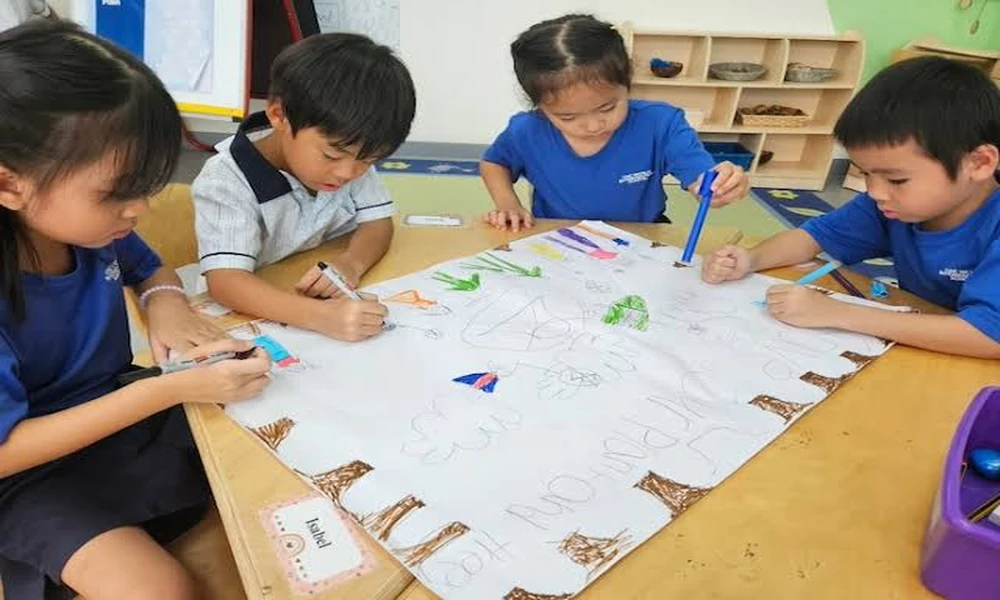

Children rarely remember answers handed to them. They do remember puzzles they cracked themselves. Inquiry-based learning builds on that truth by putting questions before explanations. In an international primary school in Klang, curiosity drives lessons forward. Pupils form hypotheses, test ideas and defend conclusions with proof. Along the way, reasoning grows sharper and mistakes turn into information. Talk becomes a tool for building arguments. The habits formed in class also travel easily into family routines, shaping how young minds weigh claims for years.
Questions Come Before Answers in Inquiry
Traditional lessons open with a rule, but inquiry reverses that order. Picture a teacher placing a melting ice cube on a tray. Within minutes, pupils wonder why one edge softens faster. Their questions, not the textbook, steer the session. Thinking begins the moment a child notices something odd. That spark carries far more weight than memorized definitions.
Why Do Hypotheses Sharpen Young Reasoning?
A hypothesis forces a child to commit to a prediction. That commitment matters. Once a guess sits on paper, classmates can test and challenge it. Nine-year-olds predicting which paper towel absorbs most water must justify their pick. Reasons, not hunches, become the currency of group work. Gradually, pupils learn that confidence needs backing.
How Do Classrooms Turn Mistakes Into Data?
At an international primary school in Klang, errors become evidence. Failed experiments get recorded in lab journals for review. A typical reflection cycle looks like this:
- Students compare predicted results against actual outcomes.
- Teachers ask which variable shifted without warning.
- Groups redesign the test and run it again.
- Each child writes down one lesson learned.
Classroom Talk Builds Evidence-Based Arguments
Critical thinking grows louder when children argue respectfully. Structured talk routines give those debates shape. A pupil might say, “I disagree because the graph shows otherwise.” Sentence starters like this train young speakers to link claims with proof. Over time, the same pupils start questioning adverts, headlines and playground rumors with surprising sharpness.
What Habits Can Parents Encourage at Home?
Inquiry should not stop at the school gate. Small routines keep that questioning spirit alive:
- Answer questions with a question.
- Let children measure while cooking.
- Compare prices at weekend markets.
- Praise reasoning over correct answers.
- Leave puzzles unsolved for a day.
The Melting Ice Cube Outlasts Any Worksheet
A worksheet answer fades by the next term. The melting ice cube does not. Children who once argued about its uneven edges carry that instinct forward. Years later, the same habit questions a suspicious loan offer or a viral health claim. Science lessons are only the training ground. The real product is an adult who asks for evidence before believing anything.
FAQs
At what age can children start inquiry based learning?
Even four-year-olds can predict whether objects sink or float in water. Teachers simply scale the complexity as reasoning skills mature through the primary years.
Does inquiry slow down coverage of the curriculum?
Early units may take slightly longer to complete at first. Pupils then grasp later topics faster because core concepts stick instead of fading.
How is critical thinking assessed in primary classrooms?
Teachers review journals, observe group debates and set open-ended tasks. Rubrics reward justified reasoning rather than only the final answer.
Can inquiry work alongside exam preparation?
Yes, since modern exams increasingly test application over recall. Pupils used to explaining their thinking handle unfamiliar questions with calmer confidence.
What role does technology play in inquiry based lessons?
Tablets and simple data loggers let pupils record temperatures, sounds or plant growth over days. Used well, these tools speed up evidence gathering while the real thinking stays with the child.





Leave a Comment