
When most people think of core training, they picture crunches and planks targeting the “six-pack” muscles. But the obliques-the muscles running diagonally along the sides of your torso-play an equally important role in both function and aesthetics. Developed obliques create the angular definition that separates an average midsection from an impressive one.
The obliques are essential for developing the adonis belt and V-cut definition that many fitness enthusiasts seek. Yet effective oblique training requires moving beyond the basic exercises most people rely on. This guide covers the anatomy, function, and advanced training strategies for complete oblique development.
Oblique Anatomy and Function
Your obliques consist of two layers: the external obliques and internal obliques. Understanding their anatomy explains why certain exercises are more effective than others.
External Obliques
The external obliques are the outermost layer of lateral abdominal muscles. They originate on the lower eight ribs and insert into the linea alba (the central line running down your abs), the pubic bone, and the iliac crest (the top of your hip bone).
Their muscle fibers run diagonally downward-from lateral to medial, and from superior to inferior (think: hands in pockets direction). This fiber orientation means they produce ipsilateral lateral flexion (bending toward the same side) and contralateral rotation (rotating toward the opposite side).
Internal Obliques
Lying beneath the external obliques, the internal obliques have fibers running in the opposite direction-upward and medially. They originate from the thoracolumbar fascia, iliac crest, and inguinal ligament, inserting into the lower three ribs and the linea alba.
The internal obliques produce ipsilateral rotation (rotating toward the same side) and ipsilateral lateral flexion. They also contribute significantly to core stability and breathing mechanics.
Why Standard Exercises Fall Short
Russian twists and side planks dominate most oblique training programs, but both have significant limitations:
Russian Twists: When performed with heavy weight or speed, Russian twists often become momentum-driven hip movements rather than controlled oblique contractions. The seated position also limits range of motion and doesn’t challenge the obliques through their full function.
Side Planks: While excellent for isometric endurance, static side planks don’t produce the mechanical tension or metabolic stress that drives hypertrophy. They develop stability but not significant muscle size.
Complete oblique development requires exercises that challenge rotation, anti-rotation, lateral flexion, and anti-lateral flexion-preferably with progressive overload potential.
Advanced Oblique Exercises
Cable Woodchops (High-to-Low and Low-to-High)
Woodchops train rotational power through the obliques’ full range of motion. Set a cable pulley high (for high-to-low) or low (for low-to-high). Stand perpendicular to the cable, grip the handle with both hands, and rotate your torso as you pull the cable diagonally across your body.
The key is initiating movement from the core, not the arms. Your arms stay relatively straight-they’re just transmitting force from your rotating torso. Perform 3 sets of 12-15 reps per side.
Pallof Press with Rotation
The standard Pallof press is an anti-rotation exercise. Adding rotation transforms it into a dynamic oblique exercise. Begin in the standard Pallof position-standing perpendicular to the cable, arms extended. Slowly rotate your torso toward the anchor point, controlling the cable’s pull, then rotate away.
This combination of anti-rotation resistance with controlled rotation creates significant oblique tension throughout. Perform 3 sets of 8-10 controlled rotations per side.
Landmine Rotations
Insert one end of a barbell into a landmine attachment or corner. Hold the other end with both hands at chest height. Rotate the bar in an arc from hip to hip, controlling the weight throughout the range of motion.
The changing resistance curve of the landmine setup-heavier at the top, lighter at the sides-matches well with oblique strength curves. Use moderate weight for 3 sets of 10-12 reps per side.
Hanging Windshield Wipers
An advanced exercise requiring significant strength. Hang from a pull-up bar, raise your legs to L-sit position (or higher), then rotate them from side to side like windshield wipers.
The combination of hip flexion with rotation creates intense oblique demand. Start with small ranges of motion and bent knees, progressing to straight legs and larger arcs as strength improves.
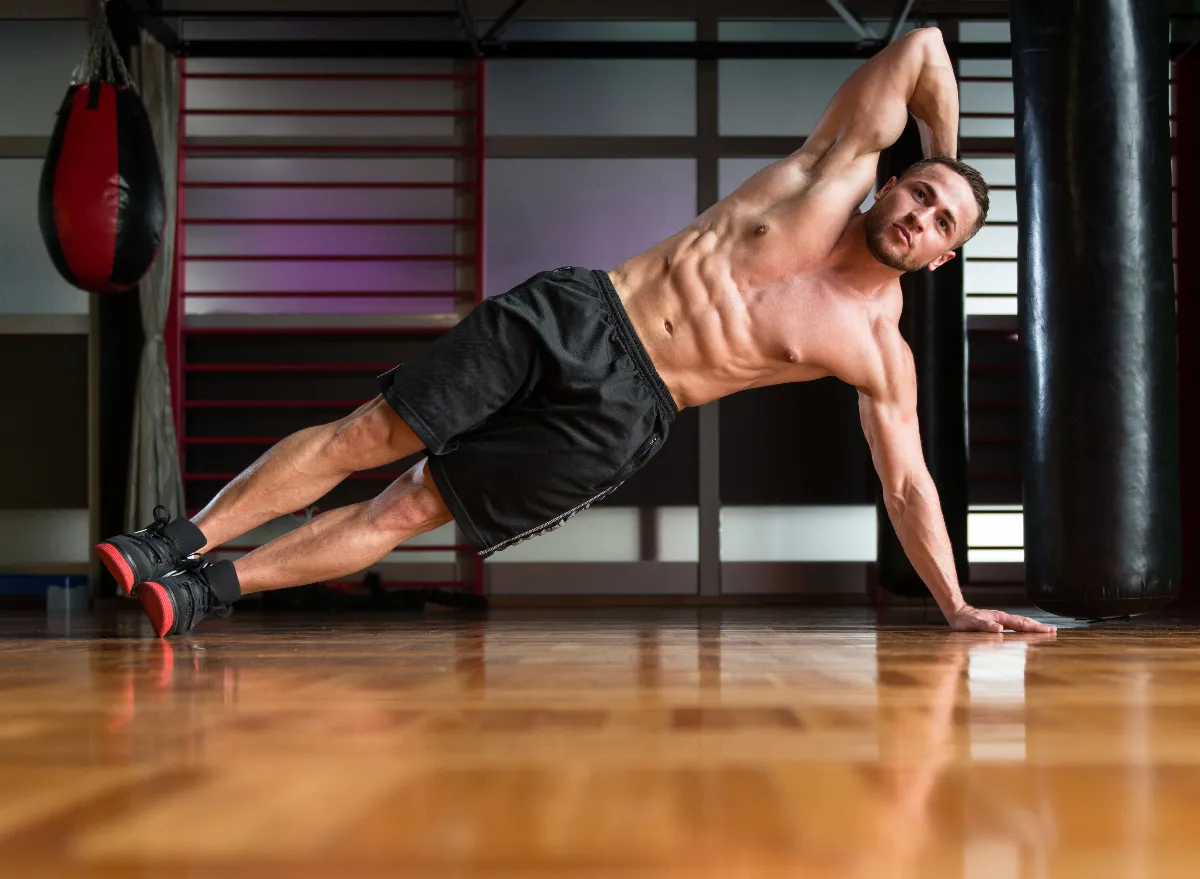
Side Plank with Hip Dips
Transform the static side plank into a dynamic exercise. From side plank position, lower your hip toward the ground, then raise it back up (and slightly higher than neutral for extra range of motion).
This movement challenges lateral flexion strength through a full range of motion rather than just isometric endurance. Perform 3 sets of 12-15 dips per side.
Offset Loaded Carries
Also called suitcase carries, holding a heavy weight on one side while walking challenges your obliques to prevent lateral flexion-a powerful anti-lateral flexion stimulus.
The key is maintaining perfectly upright posture. If you’re leaning away from the weight, it’s too heavy. Walk 40-50 meters per side for 3 sets.
Programming Oblique Training
Effective oblique programming includes exercises from multiple categories:
Rotation: Cable woodchops, landmine rotations, hanging windshield wipers
Anti-Rotation: Pallof presses, bird dogs
Lateral Flexion: Side bends with cable or dumbbell, side plank hip dips
Anti-Lateral Flexion: Suitcase carries, single-arm farmer’s walks
A balanced weekly program might include:
- 2 rotation exercises per week
- 2 anti-rotation exercises per week
- 1-2 lateral flexion exercises per week
- 1-2 anti-lateral flexion exercises per week
Spread these across 3-4 training sessions rather than performing all oblique work in a single session.
Common Oblique Training Mistakes
Over-Relying on Side Crunches
Side crunches have a limited range of motion and don’t allow significant loading progression. While they have some value, relying on them as your primary oblique exercise limits development.
Using Too Much Weight on Rotation Exercises
Heavy rotation exercises often become hip movements with arms. Reduce weight until you can perform controlled rotations initiated from your torso, not swinging motions powered by momentum.
Neglecting Anti-Rotation Work
Anti-rotation exercises build the deep stability that supports all other oblique functions. Without this foundation, heavier rotation work can lead to injury or compensatory movement patterns.
Expecting Spot Reduction
Training your obliques won’t directly reduce “love handles.” Oblique development combined with overall fat loss reveals the underlying muscle. Training alone-without appropriate nutrition-doesn’t produce visible definition.
The Aesthetic Result
Well-developed obliques create several visual effects:
The V-Line: The external obliques frame the V-cut appearance along with the inguinal ligament and lower abs.
Waist Definition: Developed obliques create the “carved” look that separates the ribcage from the hips.
Athletic Appearance: The angular definition of trained obliques suggests athletic capability and physical preparedness.
Achieving these visual results requires both muscle development (through training) and low enough body fat to reveal the muscles (through nutrition).
Conclusion
Complete oblique development requires more than side planks and Russian twists. Effective training includes rotation, anti-rotation, lateral flexion, and anti-lateral flexion exercises with progressive overload.
Cable woodchops, Pallof press variations, landmine rotations, and offset carries all provide the stimulus necessary for hypertrophy when performed correctly. Combine these with the nutritional approach necessary for your body composition goals.
The obliques tie together the entire core appearance. Their development creates the angular, athletic midsection that distinguishes a trained physique from an untrained one.