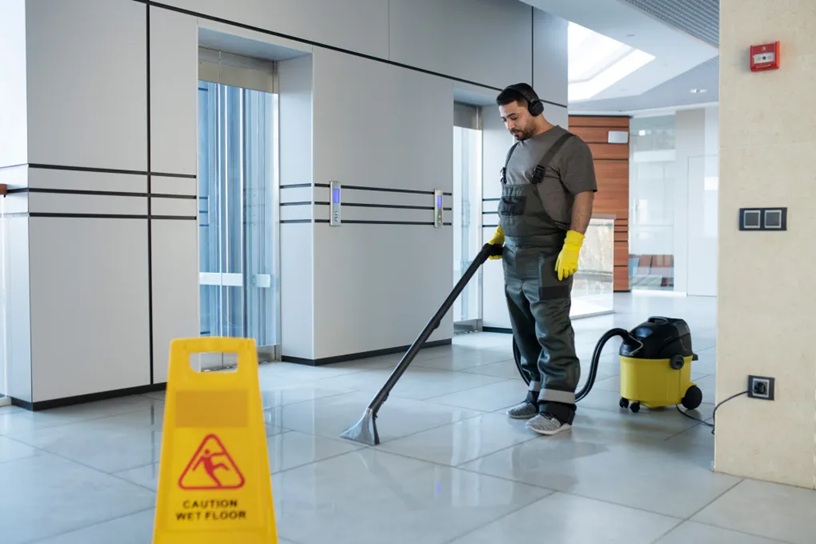

Office cleaning services operate in a parallel universe that most white-collar workers never witness, a nocturnal economy of mops and disinfectant that transforms workspaces from chaos to order whilst the professionals who created the mess sleep soundly at home. Every morning, office workers arrive to find their desks cleared, their bins emptied, their meeting rooms restored to pristine condition. The transformation seems automatic, almost magical. But there is nothing magical about it. It is the product of systematic labour performed by workers whose invisibility is not accidental but engineered into the very structure of modern office operations.
The Architecture of Invisibility
The timing tells you everything. Office cleaning teams typically work between seven in the evening and six in the morning, carefully scheduled to avoid overlap with daytime staff. This arrangement serves management’s interests perfectly. Cleaning happens without disrupting productivity. Office workers never need to step around mop buckets or wait for toilets to be serviced.
But this scheduling creates profound separation. The people who clean offices rarely meet those who use them. They become ghosts, their presence marked only by its results. When workers are unseen, their conditions can be ignored. When their labour appears effortless, its difficulty can be dismissed.
What the Work Actually Entails
Professional office cleaning services demand far more than casual observers understand:
• Systematic desk and workstation cleaning
Wiping down surfaces, emptying bins, organizing visible clutter without disturbing personal items or confidential documents
• Toilet and washroom maintenance
Deep cleaning of all fixtures, restocking supplies, addressing plumbing issues, maintaining hygiene standards
• Floor care across multiple surfaces
Vacuuming carpets, mopping hard floors, spot-cleaning stains, maintaining varied flooring materials
• Kitchen and pantry sanitation
Cleaning appliances, sinks, countertops, and floors in food preparation areas
• Meeting room preparation
Arranging furniture, cleaning whiteboards, removing rubbish, ensuring spaces are presentation-ready
• Waste management
Collecting rubbish from hundreds of bins, sorting recyclables, managing disposal
Each task must be completed quickly yet thoroughly. The standards are unforgiving. A single complaint triggers management response. Yet excellent work, performed night after night without failure, generates no recognition.
The Singapore Reality
Singapore’s office cleaning services sector operates under particular pressures. The city’s reputation for cleanliness creates expectations that border on obsessive. Office buildings in the Central Business District maintain standards that would exhaust workers anywhere.
One cleaner with fifteen years’ experience in Singapore office buildings described the reality: “Every night is the same. You have your floors, your list of tasks, your time limit. The work must be perfect. If someone complains, the supervisor blames you. But if everything is clean, nobody notices. You are invisible unless something goes wrong.”
That statement captures the essential injustice. The work is judged only by its failures, never celebrated for its successes. Cleaners operate in a system designed to minimize their visibility whilst maximizing their accountability.
The Economics of Exploitation
Here is what few office managers acknowledge: their affordable cleaning contracts depend on systematic underpayment of workers. The industry operates through layers of subcontracting that obscure responsibility and suppress wages. Building owners contract with facility management firms, who subcontract to cleaning companies, who employ workers at the lowest possible rates.
This structure serves its purpose brilliantly. When workers have grievances, they face contractors, not the corporations whose offices they clean. When cleaning companies bid for contracts, they compete primarily on price, driving a race to the bottom.
Consider the mathematics. An office cleaner might be responsible for three floors, perhaps 5,000 square metres, to be cleaned thoroughly in a six-hour shift. That allows roughly four square metres per minute. The pace is relentless. The compensation is inadequate.
The Hidden Costs
The physical toll of office cleaning work rarely appears in any accounting. Workers spend hours bending, reaching, lifting, and walking. They are exposed to cleaning chemicals that can damage skin and respiratory systems. They work in isolation, without the social connections that make other jobs bearable.
One rarely considered cost is dignity. Office cleaners frequently describe feeling invisible, treated as infrastructure rather than as human beings. Office workers leave personal messes without thought. They ignore cleaners working nearby. The message is clear: your labour matters, but you do not.
What Must Change
Reform of office cleaning services requires confronting uncomfortable truths about how we organize work and distribute value. Living wages must become standard. Direct employment by building owners should replace subcontracting chains. Reasonable workloads based on what humans can actually accomplish must replace quotas designed to maximize contractor profits.
More fundamentally, office workers need to recognize their complicity. The clean desks and spotless toilets result from someone’s labour, performed in conditions most office professionals would find intolerable. Acknowledging this, treating cleaners with basic respect, and supporting efforts to improve their conditions costs nothing but requires abandoning comfortable fictions.
The Reckoning
The office buildings that house modern commerce depend absolutely on cleaning staff who remain deliberately invisible. This invisibility enables exploitation that should shame everyone who benefits from it. Every cleaned desk, every sanitized toilet, every emptied bin represents someone’s effort, typically performed for wages that barely sustain life.
We can continue to ignore this reality, to take clean offices for granted whilst dismissing the workers who make them possible. Or we can acknowledge that a society’s character is revealed not in how it treats its most privileged members but in how it treats those who perform its essential yet undervalued labour. Excellence in office cleaning services must mean excellence in how we compensate and respect the workers who provide them.